An EMOM (every minute on the minute) starts a set of work at the top of every minute. Whatever is left of the minute is your rest, and the next set starts when the clock says so. “EMOM 10: 12 wall balls” means 12 wall balls at 0:00, 1:00, 2:00 and so on, ten times. The work is fixed, the clock is fixed, and the only thing you control is how much rest you earn.
How does an EMOM work?
Start the clock. At 0:00 you do the work for the first round. When you finish, you rest until 1:00, then start the next round. The workout ends after the last round. There’s usually no score: the goal is to finish the work inside every minute.
Common variations:
- Longer intervals. “Every 2:00 for 5 sets” (sometimes written E2MOM) gives you room for bigger sets or heavier lifts.
- Alternating EMOMs. “Minute 1: 12 wall balls, minute 2: 10 burpees” rotates exercises. A 20-minute alternating EMOM is 10 rounds of each.
- Stations. Three or four exercises in turn, so each one comes round less often and gets more rest.
- Two exercises in one minute. “5 power cleans + 10 burpees every minute” puts a couple in the same round, which leaves less rest.
For how the EMOM compares with AMRAPs, rounds for time and Tabata, see workout formats explained.
Is an EMOM easier than an AMRAP or rounds for time?
For the same work, yes: the rest is built in. Smith and colleagues had 12 trained athletes do the same five rounds of power cleans, pull-ups, dumbbell thrusters and burpees twice, once as a 20-minute EMOM and once as rounds for time. The EMOM took longer, but every measure of strain was lower: an average heart rate of 153 against 171 bpm, blood lactate of 6.5 against 11.2 mmol/L, and a rating of perceived effort of 4 against 7 out of 10. The authors concluded that the EMOM “may be more suitable for technique development and recovery in trained individuals” (Smith et al., 2024).
Atlon’s data shows the same shape. In the median EMOM, athletes spent 20% of the time working. In AMRAPs it was 53% and in rounds for time 49%.
| Format | Time spent working (median) | Median rest between sets |
|---|---|---|
| EMOM | 20% | 30 s |
| Intervals | 41% | 13 s |
| Rounds for time | 49% | 13 s |
| AMRAP | 53% | 13 s |
That doesn’t make every EMOM easy. Put enough work in the minute and the rest disappears. The format is as hard as the work you choose.
How much work should I put in each minute?
Choose work you can finish with rest to spare, and keep it there for every round. A useful check: if the first round leaves you only a few seconds, the later rounds won’t fit. Scale the reps or the load down.
Atlon athletes mostly leave a good margin. In 1:00 EMOMs, the median athlete finished the round’s work with about 25 seconds of the minute left, and that held from round 1 to round 9. Put another way, the typical round’s work, including getting set up, took a little over half the minute.
Rest does get shorter towards the end. In the last third of an EMOM, the median gap between two sets was 21 seconds, against 35 seconds in the first third. So keep some margin in the first rounds.
How long are most EMOMs?
Ten minutes is the most common length. Of the EMOMs recorded with Atlon, 23% lasted 10 minutes, 20% lasted 6 to 9 minutes and 19% lasted 11 to 14 minutes. The median EMOM lasted 10 minutes, shorter than the median AMRAP (14 minutes) or rounds for time (13 minutes).
The most common interval is 1:00, used in about 4 in 10 EMOMs.
Which exercises work well in an EMOM?
Exercises you can do well under a little fatigue and finish in a predictable time. In Atlon’s data, the most-trained exercises in EMOMs were pull-ups (9% of EMOM sets) and snatches (9%), then rowing and squats (both 5%), shoulder-to-overhead (4%) and burpees (2%).
EMOMs suit skill and barbell work because the rest keeps your form sharp. A heavy snatch every minute for 10 minutes gives you 10 good attempts with time to reset between them. That’s the “technique development” use Smith and colleagues describe.
Cardio machines work too, with a target per minute (“12 calories on the bike”). If you can’t hit it, the minute tells you so straight away.
How do I time an EMOM on Apple Watch?
Use a timer that starts each round for you and shows the time left in the minute. In Atlon:
- Open Atlon on your Apple Watch and swipe to EMOM.
- Tap the settings pill and set Every (the interval, from 0:15 to 5:00) and Rounds (1 to 50). A 10-minute EMOM is 10 rounds every 1:00.
- Press play. Each round starts by itself.
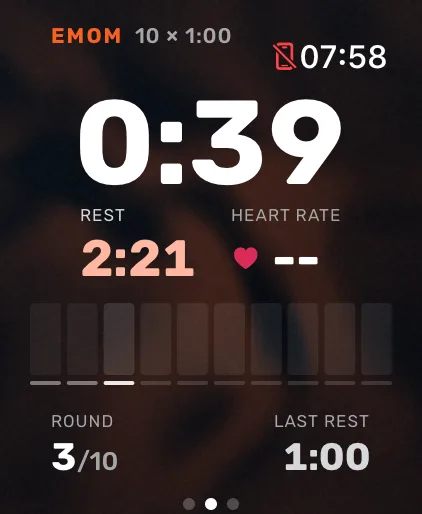
During the EMOM, the time left in the minute leads the screen. For intervals of a minute or longer, the watch taps your wrist halfway through, with 10 seconds to go and as the next round starts. After the first minute, Atlon also shows how much rest you got in the round before. Atlon recognises your exercises and counts your reps in every round, so you don’t have to count them yourself. Step-by-step setup
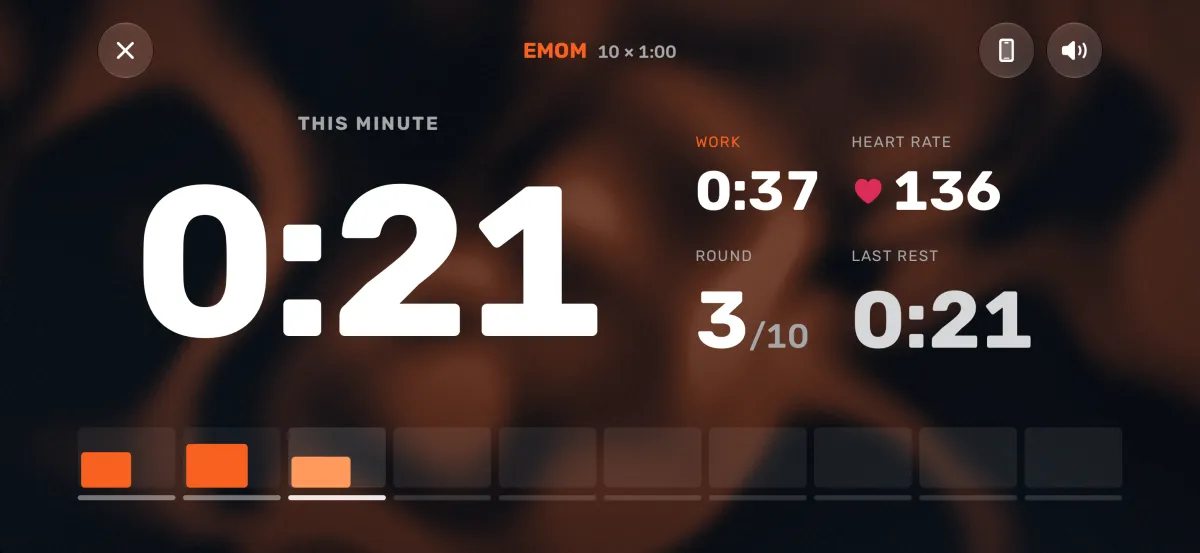
Training in a class? Prop your iPhone up and it shows the same EMOM full screen, with countdown beeps, while your watch runs it. Use your iPhone as a gym timer
For an alternating EMOM, set the total number of minutes as the rounds and just do the exercise for each minute: Atlon recognises each one. An EMOM whose interval changes partway through needs Atlon’s Just train mode, or the closest fixed EMOM. How to enter a complex WOD
What Atlon’s data says about EMOMs
| Median | |
|---|---|
| Length | 10 min |
| Time spent working | 20% |
| Rest between sets | 30 s |
| Rest between sets, first third of the EMOM | 35 s |
| Rest between sets, last third | 21 s |
| Time left in the minute after the work, 1:00 EMOMs, rounds 1–9 | about 25 s |
Method. Atlon’s 30,000 most recent workouts between 1 minute and 2 hours long, excluding test and deleted workouts; the EMOMs among them. Time spent working is the time in detected sets divided by the workout’s length. Rest is the gap between two recognised sets, including transitions. The interval is the median time between the watch’s round changes, and EMOMs whose rounds weren’t evenly spaced are left out of the interval and per-round figures. Every figure is based on at least 100 athletes. Atlon users mostly do functional fitness with an Apple Watch, so they aren’t a random sample of everyone who trains.
This is general information about a workout format, not coaching advice. Scale any workout to your level.
Get Atlon free on the App Store
Sources
- Smith JS, Bellissimo GF, Amorim FT. The physiological responses to volume-matched high-intensity functional training protocols with varied time domains. Frontiers in Physiology, 2024;15:1511961.
- Atlon: aggregate data from the 30,000 most recent workouts (method above)