Athletes rest far less than most training advice suggests. In Atlon’s 30,000 most recent workouts, the median rest between two sets was 17 seconds. Half of all rests were between 7 and 44 seconds. In AMRAPs and rounds for time the median was 13 seconds. Only in strength sessions did athletes rest the minute or more that lifting guidelines describe: a median of 92 seconds.
How long do athletes rest between sets?
A median of 17 seconds, counting every gap between two recognised sets in the same workout. That includes walking to the next station and chalking up, so the rest you’d feel standing still is a little shorter.
It depends a lot on the format:
| Format | Median rest | Middle half of rests |
|---|---|---|
| AMRAP | 13 s | 6–24 s |
| Rounds for time | 13 s | 6–25 s |
| Intervals | 13 s | 6–35 s |
| Just train (open sessions) | 16 s | 7–40 s |
| EMOM | 30 s | 10–56 s |
| Strength | 92 s | 41–140 s |
In AMRAPs and rounds for time, the clock punishes rest, and athletes keep it short. EMOMs build rest into every minute, so it more than doubles. Strength sessions are a different kind of training altogether.
How long do athletes rest when they break up a set?
It depends on the exercise. Two sets of the same exercise back to back usually means the athlete split a set: 30 wall balls done as 15, a breath, and 15. The rest in that break ranges from a few seconds to almost two minutes.
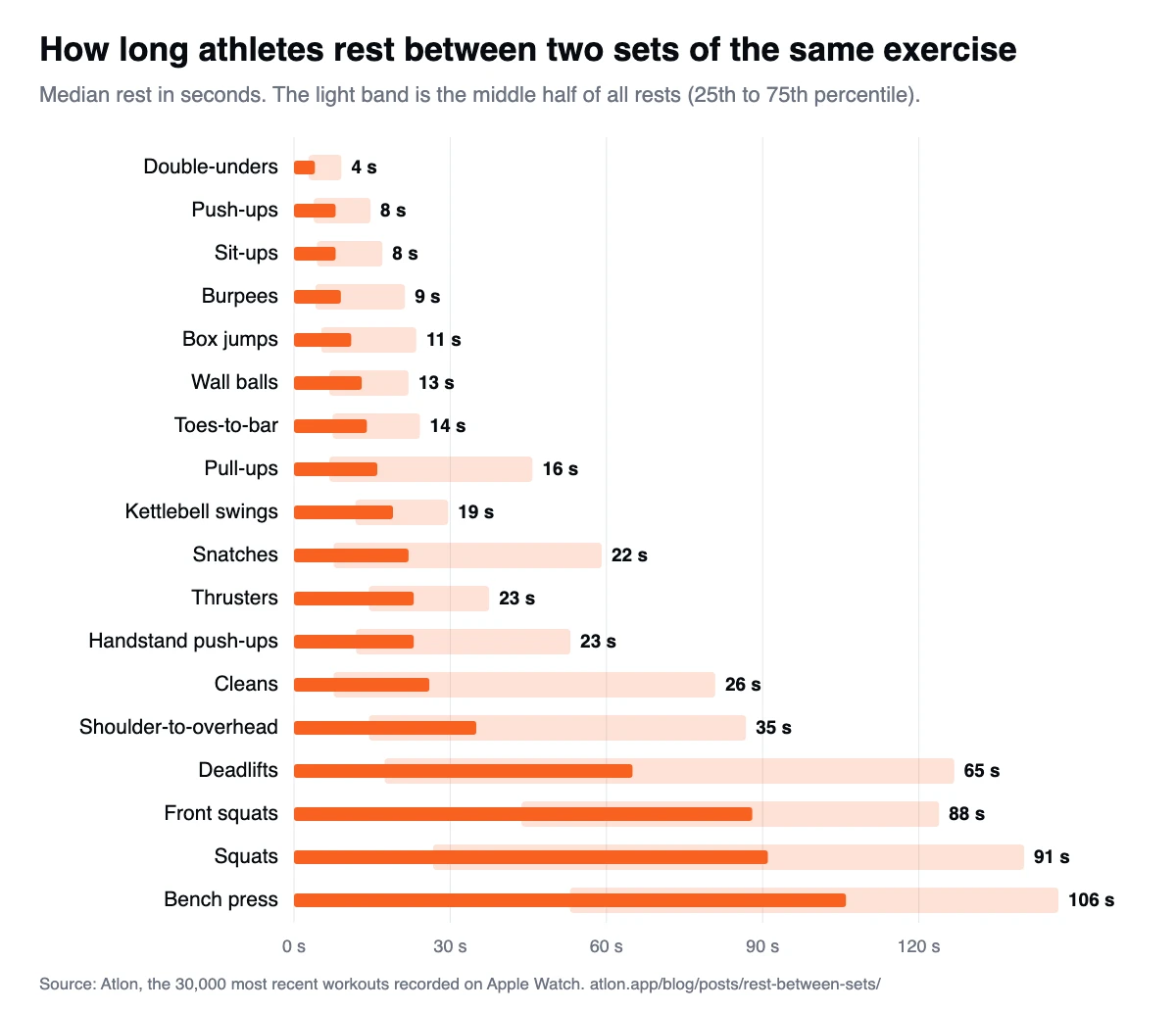
The pattern is clear. Skipping and bodyweight moves take a few seconds: shake out the arms and go again. Gymnastics and kettlebells sit in the middle. Barbell lifts take longest, and the heavier and slower the lift, the longer the break: 26 seconds between sets of cleans, more than a minute for deadlifts, and around a minute and a half for squats and bench press.
The ranges matter as much as the medians. Between two sets of pull-ups, half of all rests fell between 7 and 46 seconds: some athletes break for a breath, others need a proper rest. For pacing advice on where to break a set, see how to split your sets.
Do athletes rest more as they get tired?
Not in the way you’d expect. Across all workouts, the median rest was 17 seconds in the first third of a workout, 19 seconds in the middle third and 16 seconds in the last.
| Format | First third | Middle third | Last third |
|---|---|---|---|
| AMRAP | 11 s | 15 s | 12 s |
| Rounds for time | 11 s | 15 s | 13 s |
| EMOM | 35 s | 32 s | 21 s |
| Strength | 97 s | 98 s | 71 s |
In AMRAPs and rounds for time, rest creeps up in the middle and drops again at the end, when the finish is in sight. In EMOMs and strength sessions, rest is shortest in the last third. The data doesn’t say why: it could be lighter work at the end of a session, the end in sight, or the clock leaving less room.
The middle of a workout is where the time goes. Round times tell the same story: in AMRAPs, the median second round took 16% longer than the first, and the fourth 29% longer. See workout formats explained.
What do athletes do between two different exercises?
Changing station is quick when the equipment is close and slow when it isn’t. The median gap from pull-ups to push-ups was 6 seconds, and from push-ups to air squats 3 seconds: the classic bodyweight triplet needs no setup. Moving to or from a machine takes longer: 16 seconds from a run to wall balls, 21 seconds from the rower to wall balls and 24 seconds from burpees to the rower, where you strap in.
| Change | Median gap |
|---|---|
| Push-ups → air squats | 3 s |
| Pull-ups → push-ups | 6 s |
| Rowing → burpees | 15 s |
| Running → wall balls | 16 s |
| Running → pull-ups | 18 s |
| Rowing → wall balls | 21 s |
| Burpees → rowing | 24 s |
If you want a faster time, transitions are free seconds: set up stations close together and know where you’re going next.
How much rest do you actually need?
It depends on what you’re training for, and the research gives two useful reference points.
For lifting. A 2024 meta-analysis of nine studies found “a small hypertrophic benefit to employing inter-set rest interval durations >60 s”, but “did not detect appreciable differences in hypertrophy when resting >90 s between sets” (Singer et al., 2024). Atlon athletes’ median rest in strength sessions, 92 seconds, is right at that point.
For conditioning. Short, hard efforts run largely on phosphocreatine, and it comes back slowly. After a 30-second all-out sprint, it took about 57 seconds to recover half of it, and after 90 seconds it was only back to 65% of its resting level (Bogdanis et al., 1995). So a 13-second rest in an AMRAP isn’t recovery. It’s a pause that lets you keep moving, and that’s the point of the format: the work stays hard because the rest stays short.
This is general information, not coaching advice. How long you rest should follow the goal of the session and your coach’s plan.
How does Atlon measure rest?
Atlon splits every workout into work and rest on your Apple Watch, recognises the exercise in each set and counts the reps, with no buttons to press. Its work vs. rest detection is >98% accurate. After the workout you can see each set and the rest around it on your iPhone. In an EMOM, the watch also shows how much rest you got in the minute before. Can Atlon tell work from rest? · How does Atlon measure effort?
The data
| Exercise (same exercise, back to back) | 25th percentile | Median | 75th percentile |
|---|---|---|---|
| Double-unders | 3 s | 4 s | 9 s |
| Push-ups | 4 s | 8 s | 15 s |
| Sit-ups | 4 s | 8 s | 17 s |
| Burpees | 4 s | 9 s | 21 s |
| Box jumps | 5 s | 11 s | 24 s |
| Wall balls | 7 s | 13 s | 22 s |
| Toes-to-bar | 7 s | 14 s | 24 s |
| Pull-ups | 7 s | 16 s | 46 s |
| Kettlebell swings | 12 s | 19 s | 30 s |
| Snatches | 8 s | 22 s | 59 s |
| Thrusters | 14 s | 23 s | 38 s |
| Handstand push-ups | 12 s | 23 s | 53 s |
| Cleans | 8 s | 26 s | 81 s |
| Shoulder-to-overhead | 14 s | 35 s | 87 s |
| Deadlifts | 17 s | 65 s | 127 s |
| Front squats | 44 s | 88 s | 124 s |
| Squats | 27 s | 91 s | 140 s |
| Bench press | 53 s | 106 s | 147 s |
Method. Atlon’s 30,000 most recent workouts between 1 minute and 2 hours long, recorded on Apple Watch, excluding test and deleted workouts. Rest is the time from the end of one recognised set to the start of the next in the same workout, so it includes transitions. A stretch Atlon couldn’t classify breaks the pair, because it may have been work, and gaps over 10 minutes are left out. Exercises are the watch’s recognition, corrected by the athlete where they edited it; recognition accuracy varies by exercise. A set the athlete paused in can show as two sets with a short gap, which pulls some medians down. Every figure is based on at least 100 athletes. Atlon users mostly do functional fitness with an Apple Watch, so they aren’t a random sample of everyone who trains.
How to cite this: Atlon, “How long athletes really rest between sets in a WOD”, November 2026, https://atlon.app/blog/posts/rest-between-sets/
Get Atlon free on the App Store
Sources
- Singer A, Wolf M, Generoso L, et al. Give it a rest: a systematic review with Bayesian meta-analysis on the effect of inter-set rest interval duration on muscle hypertrophy. Frontiers in Sports and Active Living, 2024;6:1429789.
- Bogdanis GC, Nevill ME, Boobis LH, et al. Recovery of power output and muscle metabolites following 30 s of maximal sprint cycling in man. Journal of Physiology, 1995;482(2):467–80.
- Atlon: aggregate data from the 30,000 most recent workouts (method above)