Pull-ups are the most-trained exercise in functional fitness. In Atlon’s 30,000 most recent workouts, they made up 7.7% of all recognised sets, ahead of running (5.5%), snatches (5.2%), push-ups (4.7%) and squats (4.4%). Three in four athletes did pull-ups at least once. Double-unders, though, account for the most reps: almost one rep in ten.
Which exercises do athletes train most?
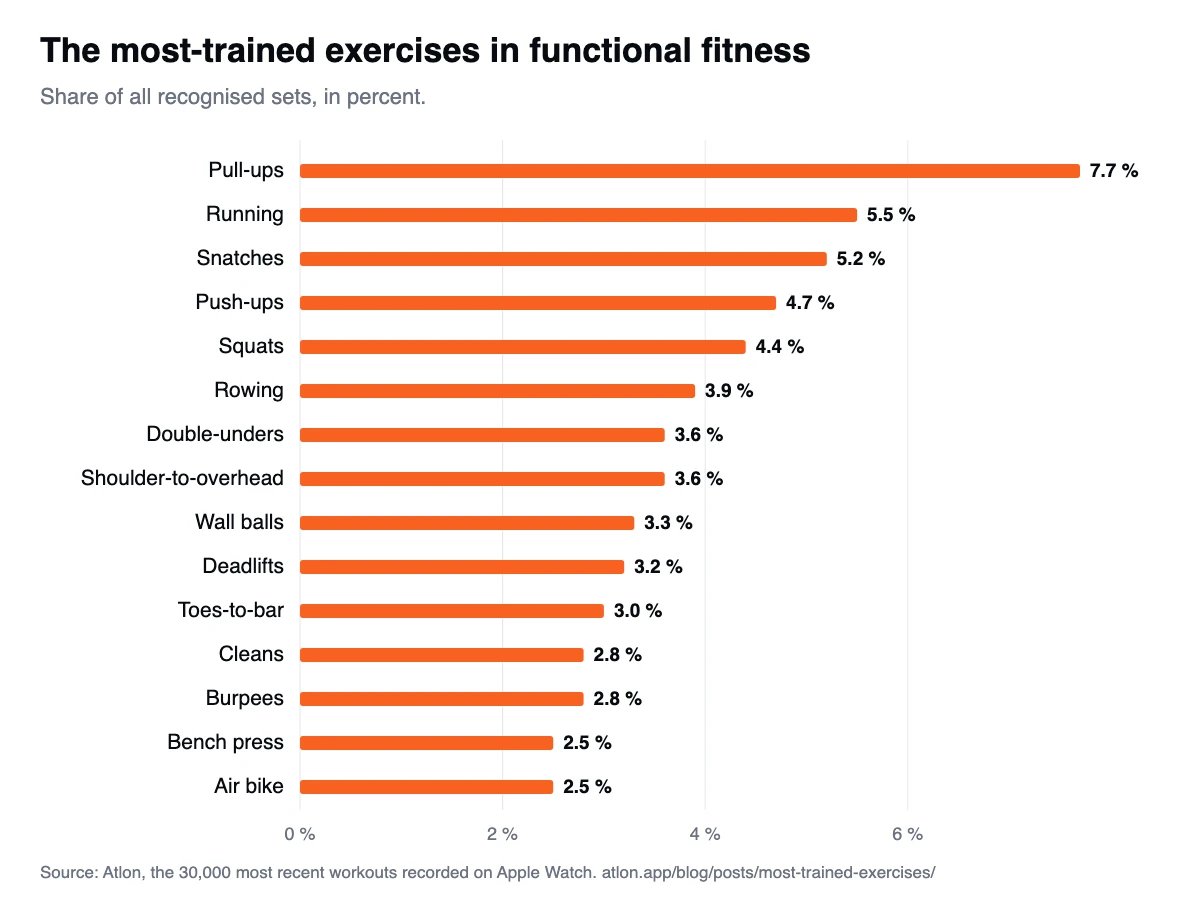
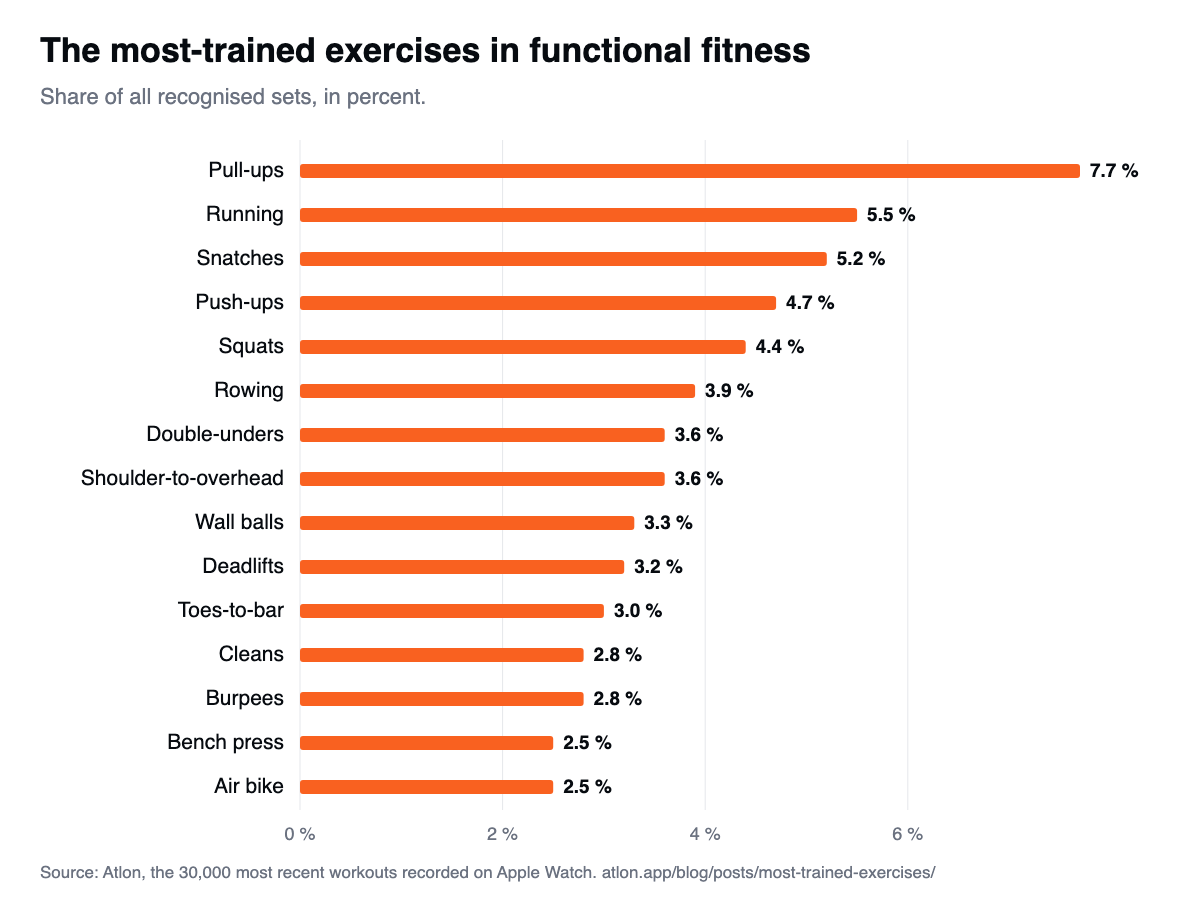
The top 15 cover the whole of functional fitness: gymnastics (pull-ups, push-ups, toes-to-bar), Olympic lifting (snatches, cleans, shoulder-to-overhead), strength (squats, deadlifts, bench press), cardio machines and running, and the classic conditioning moves (double-unders, wall balls, burpees). No single family dominates.
Two things stand out. Snatches are the third most-trained exercise, ahead of push-ups and squats: Olympic lifting is a big part of what these athletes do. And cardio is everywhere: running, rowing and the air bike are all in the top 15, and running is the second most-trained exercise of all.
| Exercise | Share of sets | Share of athletes who did it |
|---|---|---|
| Pull-ups | 7.7% | 74% |
| Running | 5.5% | 72% |
| Snatches | 5.2% | 62% |
| Push-ups | 4.7% | 67% |
| Squats | 4.4% | 75% |
| Rowing | 3.9% | 68% |
| Double-unders | 3.6% | 53% |
| Shoulder-to-overhead | 3.6% | 67% |
| Wall balls | 3.3% | 60% |
| Deadlifts | 3.2% | 63% |
| Toes-to-bar | 3.0% | 53% |
| Cleans | 2.8% | 64% |
| Burpees | 2.8% | 65% |
| Bench press | 2.5% | 56% |
| Air bike | 2.5% | 55% |
Which exercises get the most reps?
Skipping. Double-unders were 9.6% of all reps counted, and single-unders 7.7%, because they come in big sets: a median of 8 double-unders and 23 single-unders per unbroken set. After them come squats and pull-ups (6.7% each), push-ups (6.2%), wall balls (5.9%) and sit-ups (5.3%).
Running, rowing and the other machines don’t count here: they’re measured in distance or calories, not reps.
Do athletes train different exercises in each format?
A little. Pull-ups lead almost everywhere, but what follows them depends on the clock.
| Format | Most-trained exercises |
|---|---|
| AMRAP | Pull-ups, push-ups, running |
| Rounds for time | Pull-ups, snatches, running |
| EMOM | Pull-ups, snatches, rowing |
| Just train (open sessions) | Pull-ups, running, snatches |
| Strength | Squats, bench press, cleans |
AMRAPs lean on bodyweight moves that keep you moving. EMOMs and rounds for time make more room for the barbell: snatches are 9% of all EMOM sets. In strength sessions the big lifts take over: squats are 13% of all sets, bench press 9% and cleans 7%. For what each format is and how to pace it, see workout formats explained.
How big is a typical set, and how fast are the reps?
Smaller than the workout on the whiteboard suggests. A set here is one unbroken stretch of work: when you split 30 wall balls into 15 and 15, that’s two sets. The median set of pull-ups was 4 reps, of wall balls 9 and of kettlebell swings 10.
| Exercise | Reps per set (median) | Middle half | Seconds per rep (median) |
|---|---|---|---|
| Single-unders | 23 | 11–44 | 0.5 |
| Double-unders | 8 | 3–20 | 0.7 |
| Push-ups | 6 | 3–10 | 1.5 |
| Toes-to-bar | 5 | 3–9 | 1.8 |
| Kettlebell swings | 10 | 7–14 | 1.9 |
| Wall balls | 9 | 5–12 | 2.0 |
| Deadlifts | 6 | 4–9 | 2.0 |
| Shoulder-to-overhead | 5 | 3–9 | 2.1 |
| Pull-ups | 4 | 2–6 | 2.2 |
| Squats | 7 | 4–11 | 2.3 |
| Sit-ups | 10 | 7–15 | 2.4 |
| Handstand push-ups | 4 | 3–7 | 2.4 |
| Thrusters | 5 | 3–7 | 2.7 |
| Snatches | 3 | 1–6 | 3.1 |
| Box jumps | 8 | 5–12 | 3.1 |
| Cleans | 3 | 1–5 | 3.2 |
| Burpees | 5 | 3–9 | 4.0 |
Use the pace column to estimate a workout before you start. 50 wall balls at a median 2.0 seconds a rep is about 1:40 of work, before any rest. For where to break a big set, see how to split your sets.
How does Atlon know which exercise you did?
Atlon recognises the exercise on your Apple Watch from the movement of your wrist, counts the reps and splits the workout into sets, with nothing to press. Its exercise detection is >96% accurate and rep counting >92%. You can correct an exercise, and Atlon remembers. Recognition gets better with every release. For the full picture of tracking a WOD on your watch, see the complete guide and how Atlon differs from the Apple Workout app.
The data
Method. Atlon’s 30,000 most recent workouts between 1 minute and 2 hours long, recorded on Apple Watch, excluding test and deleted workouts. An exercise is the watch’s recognition, corrected by the athlete where they edited it; recognition accuracy varies by exercise. Shares of sets count every recognised set; sets Atlon couldn’t classify are left out. Shares of reps count only exercises measured in reps, and some sets of bench press and front squats have no rep count, so their share of reps is understated and left out. Seconds per rep is the set’s duration divided by its reps, for sets of at least 2 reps; it’s approximate, because a set’s start is detected near its first rep. Lunges are left out of the pace figures. “Share of athletes” is the share of athletes in the period who did the exercise at least once. Every figure is based on at least 100 athletes. Atlon users mostly do functional fitness with an Apple Watch, so they aren’t a random sample of everyone who trains.
How to cite this: Atlon, “The most-trained exercises in functional fitness (2026)”, November 2026, https://atlon.app/blog/posts/most-trained-exercises/
Get Atlon free on the App Store
Sources
- Atlon: aggregate data from the 30,000 most recent workouts (method above)