Partly. On its own, Apple Watch records a strength session’s time, heart rate and calories: Apple’s Workout app has Traditional and Functional Strength Training, but neither counts reps or logs sets. To log the lifting itself, you need an app that reads the watch’s motion sensors. Atlon’s Strength mode detects each set as you lift, names the exercise, counts the reps and logs the weight you set, with nothing to type between sets.
What does Apple Watch record in a strength workout on its own?
The session as a whole. Pick Traditional Strength Training (for barbell and machine lifting) or Functional Strength Training (for bodyweight and mixed work) in Apple’s Workout app, and you get the duration, your heart rate and an estimate of active calories, and the workout counts towards your Activity rings. What you don’t get is the log: which lifts, how many sets, how many reps, at what weight.
The heart rate is good. The calories are a rough guide, and roughest of all for lifting: in one lab study, the watch reported 299 kcal for a resistance session that measured 141 kcal (Lee et al., 2026). See how accurate Apple Watch calories are for HIIT.
How does a strength session log itself?
The watch has an accelerometer and a gyroscope that measure every movement of your wrist, and third-party apps can read them during a workout. Atlon uses them in three steps, all on the watch:
- It finds the sets. It separates lifting from resting. A short pause inside a set, like re-racking for a few seconds, stays one set.
- It names the exercise. A deadlift moves your wrist differently from a front squat or a bench press.
- It counts the reps in each set.
You add the one thing the watch can’t sense: the weight on the bar. Set it while you load the bar, and Atlon shows your last set to start from. When a set ends, its card shows the exercise, reps and weight. If the exercise is wrong, change it on the card, and Atlon uses your correction for the rest of the workout.
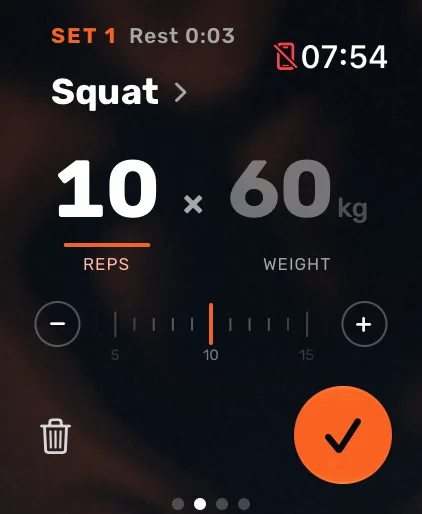
Atlon’s exercise detection is >96% accurate and rep counting >92%, and recognition gets better with every release. Recognised lifts include bench press, cleans, clean and jerks, deadlifts, front squats, overhead squats, shoulder-to-overhead, snatches and thrusters.
What does a logged session look like?
Here’s one athlete’s deadlift session, recorded with Atlon’s Strength mode: three sets of 10, then five sets of 5. The watch found all eight sets and timed each one and the rest between them.
| Set | Reps | Time in the set | Rest before the set |
|---|---|---|---|
| 1 | 10 | 0:35 | — |
| 2 | 10 | 0:25 | 1:10 |
| 3 | 10 | 0:24 | 1:44 |
| 4 | 5 | 0:14 | 2:20 |
| 5 | 5 | 0:13 | 2:15 |
| 6 | 5 | 0:13 | 2:05 |
| 7 | 5 | 0:16 | 2:08 |
| 8 | 5 | 0:13 | 2:28 |
A few things show up that a notebook wouldn’t record. The rests grew as the sets got heavier, from about a minute to well over two. The sets of 5 took 13 to 16 seconds each, and all eight sets together took about two and a half minutes of a 17-minute session. And every set’s time, reps and rest are there to compare with next week, without writing anything down.
This is one athlete’s session, not a typical one. Across all strength sessions recorded with Atlon, the median rest between sets was 92 seconds.
What do strength sessions on Atlon usually look like?
Short and focused. The median strength session recorded with Atlon lasted 16 minutes, with 7 sets of 2 exercises. That fits a strength piece at the start of a class or a short lifting session on its own. Half of all sessions had between 5 and 11 sets.
| Lift | Share of strength sets | Median reps per set | Median rest between sets of it |
|---|---|---|---|
| Squats | 13% | 5 | 2:05 |
| Bench press | 9% | 5 | 2:10 |
| Cleans | 7% | 3 | 1:27 |
| Shoulder-to-overhead | 5% | 4 | 1:29 |
Heavier, slower lifts get longer rests: athletes rested over two minutes between sets of squats and bench press, and about a minute and a half between sets of cleans and overhead lifts. A 2024 meta-analysis found that resting more than 60 seconds between sets gave a small benefit for muscle growth, and found no appreciable difference beyond 90 seconds (Singer et al., 2024).
Does a strength session count in Apple Health?
Yes. Atlon saves Strength sessions to Apple Health as Traditional Strength Training, with your heart rate and active calories, so they count towards your Activity rings. On your iPhone, the Workouts tab shows every set. If you record a class in parts, like a warm-up, a strength piece and a WOD, they come together as one workout. Atlon and Apple Health · Recording a whole class
What can’t the watch tell?
- The weight. No wrist sensor can feel the load on the bar, so you set it.
- Close variations. A power clean and a squat clean are both a clean; push press and strict press are both shoulder-to-overhead. Pick the exact variation on the set card if you want it in your log.
- Exercises it doesn’t know. They’re still logged as a set, without a name. Pick the exercise on the set card.
For tracking the rest of the class, from AMRAPs to EMOMs, see the complete guide to tracking WODs and HIIT on Apple Watch. For a short answer, see Can Apple Watch track weightlifting?
Method. The worked example is one athlete’s session, shared with their permission. The figures for all strength sessions come from Atlon’s 30,000 most recent workouts between 1 minute and 2 hours long, excluding test and deleted workouts; the Strength sessions among them. Rest is the gap between two recognised sets, including moving and loading the bar. Every figure is based on at least 100 athletes.
Get Atlon free on the App Store
Sources
- Apple Support. Workout types on Apple Watch.
- Lee TH, Jun DU, Bae JY, Roh HT, Cho SY. Comparative validity of smartwatch-derived heart rate and energy expenditure during endurance and resistance exercise. Sensors, 2026;26(8):2526.
- Singer A, Wolf M, Generoso L, et al. Give it a rest: a systematic review with Bayesian meta-analysis on the effect of inter-set rest interval duration on muscle hypertrophy. Frontiers in Sports and Active Living, 2024;6:1429789.
- Atlon: aggregate data from the 30,000 most recent workouts (method above)