Start slower than you want to, and break big sets before you have to. Almost everyone slows down in an AMRAP: in Atlon athletes’ AMRAPs, the median second round took 16% longer than the first, the third 24% longer and the fourth 29% longer. Every second of that slowdown costs reps, so how evenly you go matters as much as how fast you start.
What is an AMRAP?
An AMRAP (as many rounds as possible, sometimes “as many reps as possible”) fixes the time and lets the work vary. You repeat a round of exercises until the clock runs out. Your score is the rounds you finished plus the reps of the round you were in, such as “7 + 12”. For how it compares with EMOMs and rounds for time, see workout formats explained.
How much do athletes slow down in an AMRAP?
By about a quarter to a third over the first four rounds. Atlon compares each round with the same workout’s first round, then takes the median across workouts where the athlete counted rounds:
| Round | Time compared with round 1 (median) |
|---|---|
| 1 | — |
| 2 | +16% |
| 3 | +24% |
| 4 | +29% |
The biggest jump is from the first round to the second. After that the slowdown continues but flattens.
Rounds for time slow down in the same way: +17% in the second round and +33% in the fourth.
Why does pace matter more in a longer AMRAP?
Because a fast start costs more the longer there is left to pay for it. Mangine and colleagues had 22 trained athletes do the same circuit of rowing, thrusters and box jumps as a 5-minute and as a 15-minute AMRAP. In the 5-minute version they averaged 15.5 reps a minute; in the 15-minute version, 12.4 (Mangine et al., 2025). Athletes pace themselves for the time they have, whether they plan to or not.
Sports scientists describe several ways to pace a workout: negative, positive, all-out, even, parabolic and variable. For short WODs of 10 minutes or less, de-Oliveira and colleagues expect mostly all-out or positive pacing (fast, then slower), and most non-elite athletes to end up with a variable pace on lifts and gymnastics (de-Oliveira et al., 2021).
AMRAPs recorded with Atlon have room for pacing to matter. The median lasted 14 minutes: 17% lasted 11 to 14 minutes, and 12% exactly 20 minutes.
How should I pace my first round?
A little slower than feels natural. If your rounds follow the median pattern, your first round will be about 15% faster than your average over the first four. So decide on the average pace you want and start just under it, not flat out.
Three ways to hold back without losing time:
- Break sets early. Split 15 wall balls into 8 and 7 from the first round, while a short break still brings you back. Waiting until you have to break means longer rests later. See how to split your sets.
- Keep rests short and planned. In Atlon athletes’ AMRAPs, the median rest between sets was 13 seconds. A few deliberate breaths between sets cost less than one long stop at the bar.
- Set up stations close together. Transitions count against the clock like rest does, and the walk to a machine adds up over a dozen rounds.
This is general information about pacing, not coaching advice. Scale any workout to your level.
Where does the time go in an AMRAP?
About half of it is work. In the median AMRAP, Atlon athletes spent 53% of the time in a set. The rest went to short breaks, changing stations and setting up: the median rest between two sets was 11 seconds in the first third of the AMRAP, 15 seconds in the middle third and 12 seconds in the last.
So rest creeps up in the middle of an AMRAP and comes back down towards the end. The middle is where holding your rhythm saves the most time.
The most-trained exercises in AMRAPs were pull-ups, push-ups and running.
How do I see my own round splits?
Count your rounds as you go, and look at each round’s time afterwards. In Atlon:
- Open Atlon on your Apple Watch, swipe to AMRAP and set the time cap (1 to 90 minutes).
- Press play. The clock counts down, and Atlon recognises your exercises and counts your reps.
- Tap Round as you finish each round. On watches that support double tap, tap your finger and thumb together twice instead. Counted one by mistake? Undo replaces the button for 4 seconds.
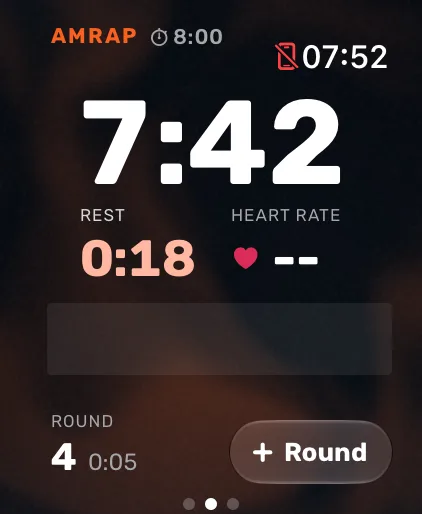
The watch taps your wrist halfway, with 10 seconds left and at 3, 2, 1. At the cap, the workout ends and shows your rounds. Each round’s time is saved, so after the workout you can see where you slowed down and plan the next attempt. How to set up an AMRAP · How to count rounds with double tap
What Atlon’s data says about AMRAPs
| Median | |
|---|---|
| Length | 14 min |
| Rounds counted | 4 (middle half: 3–6) |
| Time spent working | 53% |
| Rest between sets | 13 s |
| Round 2 compared with round 1 | +16% |
| Round 4 compared with round 1 | +29% |
Method. Atlon’s 30,000 most recent workouts between 1 minute and 2 hours long, recorded on Apple Watch, excluding test and deleted workouts; the AMRAPs among them. Round times come from the rounds the athlete counted, so only workouts with at least two counted rounds are in the round figures, and the unfinished last round isn’t counted. Workouts with a round under 5 seconds or over 30 minutes are left out. Time spent working is the time in detected sets divided by the workout’s length. Rest is the gap between two recognised sets, including transitions. Every figure is based on at least 100 athletes. Atlon users mostly do functional fitness with an Apple Watch, so they aren’t a random sample of everyone who trains.
Get Atlon free on the App Store
Sources
- Mangine GT, Staples C, Henley JW, et al. Acute effect of a multi-ingredient pre-workout supplement on pacing and kinetic expression during shorter and longer bouts of high intensity functional training. Journal of the International Society of Sports Nutrition, 2025;22(1):2529906.
- de-Oliveira LA, Heredia-Elvar JR, Maté-Muñoz JL, et al. Analysis of pacing strategies in AMRAP, EMOM, and FOR TIME training models during “Cross” modalities. Sports, 2021;9(11):144.
- Atlon: aggregate data from the 30,000 most recent workouts (method above)